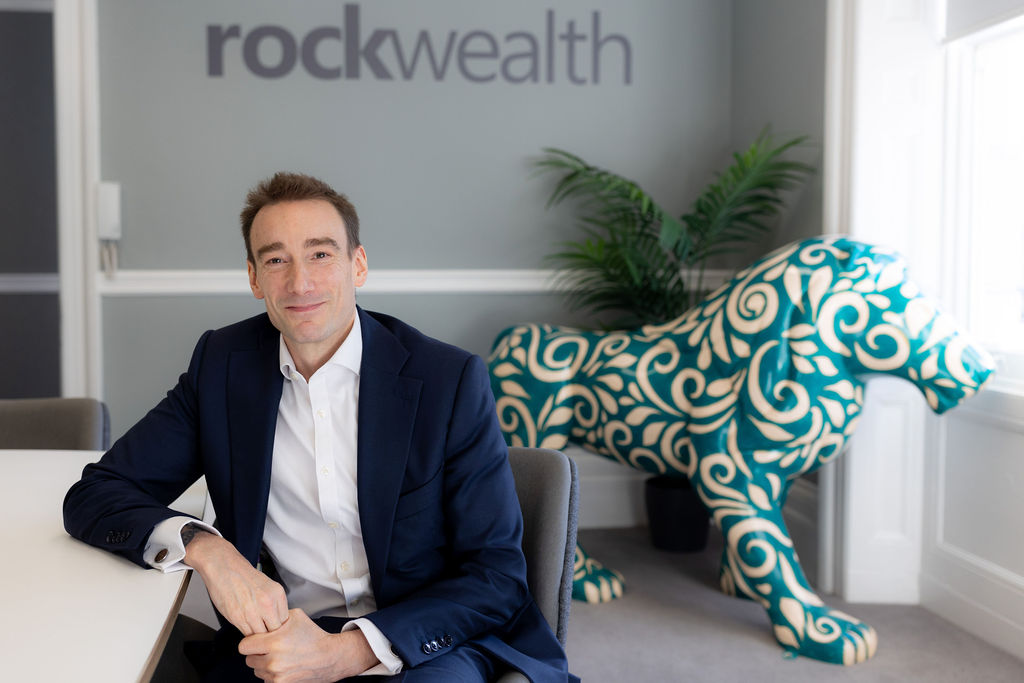




Rob Smith spent 25 years inside the UK financial industry. He saw the complexity, understood the incentives behind it, and decided there was a better way.
rockwealth Chiswick is the result: a fixed-fee, evidence-based financial planning practice built around what clients need, not what generates the most revenue.
A restaurant where nobody can explain the menu. The waiter recommends the tasting menu, naturally. 12 courses, each with a wine pairing, a foam, and a name you can't pronounce. The bill, when it arrives, is calculated not on what you ordered but as a percentage of your total wealth. The couple at the next table had the same meal. Their bill was substantially smaller than yours.
Of course, no restaurant works this way. And yet this is roughly how much of the financial advice industry has operated for years. Complex products, layered strategies, charges that rise automatically as your assets grow, a menu of options designed to impress rather than to serve.
Most investors have felt it. The quarterly statement that raises more questions than it answers. The nagging sense that something's off but it's hard to say exactly what.
Rob Smith knows where that feeling comes from. And he's built something different.
Why so much financial advice is harder to follow than it should be
The FCA has found, repeatedly, that a large share of UK adults can't understand the financial products they hold. That's not a literacy problem. It's a design problem.
Rob has seen it close up. Clients arrive, he says, "with investment portfolios laden with complex investment vehicles trying to do clever things." Absolute return funds. Structured products. Commodities. Futures. Layers of strategy stacked on top of each other, added at different points by different hands, none of it forming a coherent whole. The paperwork fills carrier bags.
Sometimes the consequences are merely expensive. Sometimes worse.
Early in his career as a stockbroker, Rob watched a client lose more than half of a £1.9m portfolio in a single day. The entire sum was in one stock: PartyGaming. When the US passed the Unlawful Internet Gambling Act in 2002, the share price collapsed. One piece of legislation, one concentrated position, one catastrophic outcome. Diversification isn't a theoretical nicety. It's the difference between a setback and a disaster.
What connects these cases isn't bad luck. It's a financial advice culture that has made things more complicated than they need to be.
The incentive problem nobody in financial services likes to talk about
Back to that restaurant. Say it charged not a fixed price per dish but a percentage of your total wealth. You and the person at the next table order the same meal. Their bill is a tenth of yours. And the more the kitchen persuades you to order, the more it earns. Would you trust the recommendations?
This is, roughly, how much of the advice industry works.
The ad valorem model (fees charged as a percentage of the assets an adviser manages on your behalf) creates a structural conflict that rarely gets discussed openly. The adviser's income rises when you invest more. It rises when markets go up. It has no direct relationship to the quality or volume of work done on your behalf.
Rob is blunt. "If you charge ad valorem, you are in an industry," he says. "If you charge fixed fees, you are a professional." Nobody pays a solicitor a percentage of their estate's value to write a will. The fee reflects the work, not the asset.
Percentage charges are a legacy of commission-based selling, the old model dressed in new clothes. The Retail Distribution Review of 2012 banned commission on investment products. The percentage-of-assets logic, in many firms, survived intact.
From Leeds stockbroker to Chiswick financial planner
Rob read politics and modern history at Manchester. Not, he'll admit, the most obvious route into financial planning.
When he graduated in 2000, financial services was the default for anyone without a better idea. "It acted like a black hole," Rob says, "attracting anyone not specifically anchored to a vocation." He wasn't anchored. In he went.
His early years as a stockbroker in Leeds were instructive in ways he hadn't expected. He watched clients take extraordinary risks. He saw a trader accidentally buy Berkshire Hathaway A shares instead of B shares: in 2005, the A shares cost $85,000 each, the B shares $55. Not a comfortable error to explain. He learned early that the detail always matters and markets don't forgive carelessness.
Stockbroking in Leeds had a ceiling. Rather than head to London, Rob studied for his financial advice qualifications while still at the desk, then persuaded a local firm to take him on as an administrator and paraplanner. Paraplanners are the researchers and cashflow analysts who sit behind an adviser's client-facing work. Coming to advice through the support roles gave him something many advisers lack: a realistic sense of what's deliverable, and when a promise made in a meeting will fall apart in the back office.
11 years at LIFT-Financial followed. It was there he encountered what financial planning could look like. Fixed fees. Cashflow modelling. Clients who were often City professionals themselves, which meant Rob had to find his value somewhere other than investment commentary.
When consolidation pressures began reshaping the firm, he took stock. He sought out two coaches, Ruth Sturkey and Lee Robertson, and spent the better part of two years visiting firms. A self-described Goldilocks phase. Too corporate here, too conventional there.
He'd spoken to Tim Horrocks and rockwealth before. He came back to them. What settled it: the firm was "absolutely geared to provide a service that promotes trust: trust from charging fairer fixed fees, trust from using low-cost evidence-based investments, and trust that the only thought process an adviser should have when speaking to a client is helping people realise their goals."
rockwealth Chiswick opened for business on 9th March 2026. Rob lives in Acton. For the first time in his career, he can walk to work.
Why Rob Smith decided simple was better
The clients who need the most help are rarely the ones who've done nothing. They're the ones who've done too much.
Rob describes them arriving with "a couple of Morrison's carrier bags full of paperwork": a pension from one job, an ISA opened during a moment of optimism, a structured product a previous adviser recommended, something they read about online. A collection of decisions. Not a plan.
Investing, he argues, comes down to one thing: grow your money above inflation so that when you spend it, it has at least the same purchasing power as when you put it away. That's the problem. Most of the complexity piled on top of it isn't solving that problem. It's obscuring it.
Global equities, held consistently and at low cost, do the job. The academic case is long-established. The Nobel Prize-winning economist William Sharpe showed in 1991 that active managers in aggregate must underperform the market before costs. It's a matter of arithmetic. Once a client accepts this, the question of what to invest in largely answers itself. "The investment piece takes care of itself," Rob says. "What we can focus on instead is building the plan."
That, in his view, is where the real work is.
What financial planning looks like with a fixed-fee financial planner in Chiswick
Working with a fixed fee financial planner means the bill reflects the work done, not the size of your portfolio. There's no structural reason for Rob to recommend you invest more than you need to. As he puts it: "rockwealth is not incentivised to recommend you invest more. For many people, not investing more is the correct option."
The third pillar of Rob's service is estate and tax planning, and it's increasingly relevant in Chiswick. The area draws City professionals, media and entertainment workers, and established families who are often asset-rich and uncertain about what comes next. Historian Eliza Filby, in Inheritocracy, estimates that £5.5 trillion in property wealth will pass from baby boomers to millennials in the UK over the next two decades. That transfer doesn't manage itself.
Rob holds the Trust and Estate Practitioner qualification from STEP (the Society of Trust and Estate Practitioners) and a Fellowship of the Chartered Insurance Institute. Where estates get genuinely complicated, he brings in specialist solicitors and accountants. "Not taking advice at the right time," he says, "can be catastrophic for some people."
Ready to make your finances simpler? Start here
Good financial planning shouldn't feel like a restaurant where nobody can explain the menu and the bill is a surprise. You should know what you're being served, what it costs, and why.
Once people in Chiswick understand that rockwealth isn't incentivised to recommend more investing, Rob says, "they will understand why we are truly different." For some, the right answer is to invest less. For others, it's to simplify what they already have. Either way, the plan is built around your goals.
If you're considering retirement planning or thinking about financial planning in Chiswick for the first time, that conversation is worth having sooner than most people expect.
The menu is straightforward. So is the bill.